The Windy Side Of The Law

A review of The Windy Side of the Law by Sara Woods – 251219

Taking its title from a line from Shakespeare’s Twelfth Night, the seventh novel in Woods’ Antony Maitland series, originally published in 1965 and the second of a batch of five of her novels reissued recently by Dean Street Press, sees the junior barrister stray dangerously near the wrong side of the law.

In the absence of that pillar of the legal establishment and acerbic forensic barrister, Sir Nicholas Harding, away convalescing, his nephew, Antony Maitland, an aspiring barrister with a penchant for sleuthing, manages to get into a pickle, finding himself at the scene of three murders and is close to being suspected of being involved in a bit of drug smuggling. Antony, though, is a victim of circumstances, his childhood friend, Peter Hammond, dragging him into a vicious and unsavoury world characterised by, to quote Virginia Pagley, drugs and thugs and amnesia.

Having returned from a sojourn in Ceylon, now Sri Lanka, Hammond finds himself in a hotel room with no memory, not even of his own name. As he comes to he finds Antony’s name in a notebook and contacts him to see whether he can piece together who he is. Antony and his wife, Jenny, recognize their old friend and lend a helping hand in trying to recover his memory. Before they can go too far, though, following a tip off to the police, a package of heroin is found in Hammond’s luggage and even worse, he finds the murdered body of a hotel valet in his bathroom and before reporting the murder to the police, drags Maitland in to help out.

Matters quickly spiral out of control with another murder at a spot where both Hammond and Maitland were and Hammond’s fingerprints are on the murder weapon. Hammond is arrested but Maitland, with barely a jot of evidence but acting upon a basic instinct that his friend is not only innocent but also a victim of a conspiracy to remove him from circulation. Maitland is also pretty convinced that the origin of Hammond’s troubles rests with the voyage back to England on the Atlantis and that he might be paying the price for inadvertently noticing something that he should not have done.

In an increasingly complicated plot which adds layer after layer of complexity to what seemed initially to be a fairly simple affair, Maitland sets out to vindicate his friend. A jade disc, a chance encounter in a restaurant, the erratic behaviour of one of Hammond’s female companions on the Atlantis and a report of experiments on a drug that causes amnesia in a medical journal put Maitland on the track to discovering what really has gone. However, as he confronts the brains behind a sophisticated drug smuggling operation, he finds himself once more at the scene of a murder and he can only be one of two suspects.

It takes a timely intervention from Sir Nicholas to extricate Antony from another fine mess and to restore order to his chambers in a case of when the cat is away, the mice will play. I enjoyed the delicious irony of a statue of Shou-Lao, the patron of long life, being instrumental for shortening the liberty of the culprit.

This is a novel that is as far from the cloistered calm of the Temple as you can get, as Woods moves away from the usual courtroom drama with Sir Nicholas striking terror into all to produce a racy and enjoyable thriller where Antony, fired with loyalty to an old friend and a sense of a grave injustice about to be done, steps out of his comfort zone with almost disastrous consequences. It is good to see a writer move away from a tried and tested formula, especially when it works.

Again Woods points out that the events occur before Trusted Like The Fox, which was published earlier, but that is really academic as the story is strong enough to stand on its own two feet. Amnesia and drugs, heroin rather than cocaine, a nod to the change in drug tastes in the 1960s, might be familiar tropes but Woods has used them with aplomb to produce a highly enjoyable story.

My thanks go to Victoria Eade for a review copy.

The Crooked Circle

Released on September 25, 1932, The Crooked Circle, a comedy-mystery directed by Bruce Humberstone, was a pretty mundane story of amateur detectives at the Sphinx Club and an evil gang known as the Crooked Circle. It did not trouble the members of the Academy of Motion Picture Arts and Sciences but it did earn a footnote in the history of cinematography. It was the first feature film to be shown on television.

In Los Angeles on March 10, 1933, the Don Lee Broadcasting System showed the film over their experimental station, W6XAO, transmitting an 80-line resolution mechanical television picture. Sadly though, there were less than half a dozen receiving sets in the greater Los Angeles area that could enjoy this landmark event. Curiously, the film was again selected for transmission by the NBC Television experimental station, WX2BS, in New York City on June 18, 1940.

Hitherto the only place to see a film was at a cinema but The Crooked Circle was the film that started the push to grant wider access to films. Nowadays, the schedules of television stations would be pretty threadbare without films to show and, of course, we can stream almost many film to our heart’s content. Truly, a landmark cinematic moment.

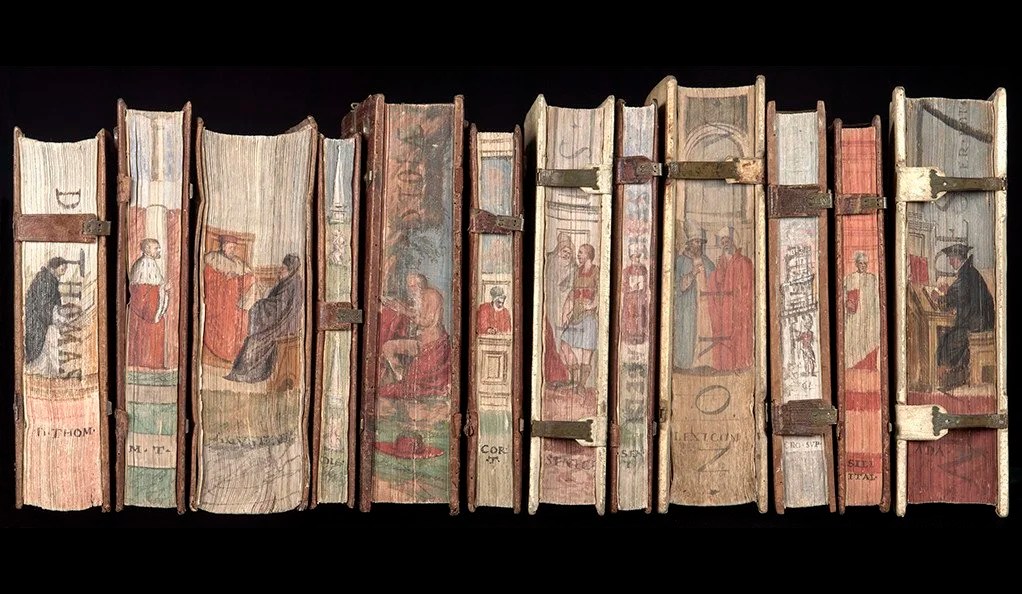
Fore-Edge Painting

For someone who has spent much of his life surrounded by physical books I have been particularly ignorant about their anatomy. Crudely put, a book is a collection of pages pressed between two covers, the front and the back, with a spine holding the pages in place and usually bears the title and the name of the author of the book. This means that there are three edges of the pages showing, the top, which is known as the “head”, the bottom known as the “tail”, and the side facing the spine, the “fore”. 

In the 10th century, the titles of books were written or impressed with heat on to the fore-edge of the book rather than the spine. This was because books were displayed horizontally on shelves and so their titles could be easily read. It took almost six hundred years before books were stored vertically and their titles embossed on their spines, leaving the fore-edge free. This was often used to display the owner’s name as books were valuable and precious things.

However, for the 16th century Italian painter and engraver, Cesare Vicellio, the fore-edge presented a blank canvas, upon which he could paint an original piece of art and which would be visible when the book was closed. Each painting would be different, providing another aid to identifying a particular book.

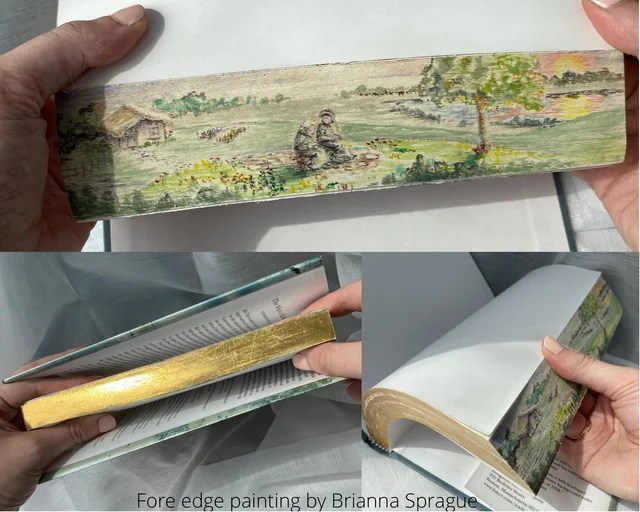
The English Restoration bookbinder and publisher, Samuel Mearne, when he was not hounding out of business printers and bookbinders who published literature that went against the current political dictates on religion and then publishing the confiscated works abroad at a great profit, is credited with taking Vicellio’s idea a step forward. Instead of painting on the flat edge of the pages when the book was shut, Meade fanned the pages slightly and put the paint on the inside edges so that the picture could only be seen when the pages were fanned.

Known as “disappearing” or “vanishing” fore-edged painting, Mearne gave his books an added twist, adding gilt, a thin layer of gold, to the outside edges, a technique that is used to this day. As well as beautifying a volume, the gilt protected the page edges from tears, and further disguised the hidden artwork. His work is considered to be a high point of pre-Industrial bookbinding.

The more widespread use of hidden fore-edge painting did not take off until the late 18th century, thanks to an eccentric family of booksellers based in the Yorkshire town of Halifax, the Edwards. Like many booksellers of the time, they had their own bindery where they pioneered the practice of adding detailed urban and rural scenery to the edges of books. Their eye-catching creations even piqued the interest of King George III and his patronage boosted the fame of the Edwards shops. The names of the painters of most of the illustrations are, sadly, unknown.

The popularity of this form has waxed and waned ever since without ever dying out. There is one fore-edge artist still plying his art in the UK, Martin Frost, while Heritage Crafts calls the skill critically endangered. If you have a book with a fore-edge painting, cherish it. I am on the look-out for one for my collection.    

Still Waters

A review of Still Waters by E C R Lorac – 251216

A reissue of another book by E C R Lorac, one of the pen names of Edith Caroline Rivet, as part of the British Library Crime Classics series is a moment to be savoured. This, the thirty-second novelin her long-running series featuring Inspector Robert Macdonald and originally published in 1949, is no conventional piece of crime fiction. Instead, rather the geological processes that have slowly created the Lunesdale landscape that is clearly so close to her heart, it builds up an intriguing story from layers of information and supposition before exploding into life as we approach the denouement.

It is a bit of a slow burner, but that characteristic fits perfectly the pace of life in a remote farming community where everyone knows everyone and a stranger sticks out like a sore thumb. Farms have been kept for generations and there is a stock of itinerant labourers, young guns with a tractor to hire.

Into all this steps Caroline Bourne, an artist who wants to escape to the country to enjoy a “serene old age” and successfully buys at auction a derelict cottage close to a large deep pool, the still waters of the novel’s title, although as we learn almost on the final page there is an amusing double play in Rivett’s choice. The behaviour of the auctioneer, who seemed to want to ignore Caroline’s bids except she thwarted him by bidding in a loud, clear voice, is the first unusual aspect upon which the plot is built. There is clearly some keenness to buy what seems an unprepossessing property as she receives a generous offer immediately after the auction.

Caroline is the cousin of Kate Doggett, whom, along with her husband, Giles, we have met before in The Theft of the Iron Dogs (1946) and will again in the later Crock O’Lune (1953). Giles fancies himself as a detective but he proves to be more of a Watson than a Holmes, although he is able to put two and two together and be a diligent accomplice. It is Kate who makes the telling observation that there has been plenty of foot traffic up to the pool recently, unexpectedly so and perhaps denoting fishy.

The third ingredient is provided by Caroline’s architect, Francis Rolph, who has the misfortunate to receive a sharp blow to the head when he was out late at night near the pool. Clearly, someone did not want him potentially snooping around. There is another blow to the head, although the victim this time, the local Inspector, Bord, is amusingly the author of his own misfortune.

Add into the mix the disappearance of David Wynne after an altercation with an itinerant farm hand, Tom Field – murder? – , Field’s suspicious behaviour, and Robert Macdonald’s unannounced arrival in the area, partly to visit his friends, the Doggetts, and partly, and more importantly, on the trail of a smuggler, William Maredeth, and the ingredients of a fascinating puzzle are in place.

The glory of the book, which its languid pace allows Rivett to develop, is her characterization and her deep affection for a remote part of Lancashire with its glorious scenery, treacherous sands, and its network of ancient by-roads and footpaths and its proximity to a main link from Carlisle to Liverpool and Manchester, ideal for nefarious operations. There may not be much of a whodunit, the eminence grise, a man of many talents, is fairly obvious but it is a satisfying tale which hangs together and is ultimately satisfying.

Entertaining, beautifully written, touching, a paean to a beautiful part of the country, it is a welcome addition to the canon of Rivett that is easily accessible, even to those whose wallets are as tightly guarded as the archetypal Scotsman.  

Buried Alive Again

Frank Vester may have paved the way with his demonstration of his safety coffin but that was nothing compared to the exploits of Count Michel de Karnice-Karnicki, who described himself as a “chamberlain to the czar of Russia”. His pride and joy was a safety coffin which he called “Le Karnice”. He toured Europe and America, demonstrating the efficacy of his contraption.

A report in The Chicago Tribune in its December 20, 1899 edition gives a flavour of his style. At a meeting of the Academy of Medicine in New York City, Dr Henry Garrigues “startled” his fellow members by announcing that one person out of every 200 buried in the United States was really “in a lethargic state and is buried alive”. This astonishing and patently untrue statement paved the way for Karnicki to put “Le Karnice” through its paces.

He claimed that he had made considerable improvements on other safety coffins because in his version the slightest movement caused a series of alarms and alerts to be triggered, causing air and light to enter the coffin and, externally, a shiny ball atop a metal tube 3.5 inches in diameter to lift into the air and a bell to ring. In this way the precise location of the coffin could be identified, allowing aid to be quickly summoned, while the victim could wile away the time by speaking to anyone who would listen via a special tube.      

Karnicki would then throw the floor open to any volunteers who wished to try the coffin out for themselves, some even allowing themselves to be buried inside one. In Turin, a 78-year-old man, Faroppo Lorenzo, consented on December 17, 1898 to be buried alive in “Le Karnice” and was not disinterred until nine days later, on December 26th, setting the world record for the longest voluntary live burial, a record which still stands today. When he resurfaced, Lorenzo’s only comment on his unusual Christmas vacation was that it was “damned smelly down there”.

One of Karnicki’s most ardent supporters was a Parisian lawyer, Emile Camis, whose pamphlet, Premature Burial: Its Prevention, addressed the widespread fear of being buried alive and proposed “Le Karnice” as the solution. “The most authorised professors, the most renowned physicians, the most competent hygienists”, he wrote,  “who have tried the ‘Karnice,’ have been unanimous in their appreciations favourable to its immediate application.”

Despite these enthusiastic endorsements and enterprising demonstrations, there is no evidence that Karnicki’s safety coffin nor any other caught on. One major design flaw was that during the process of decomposition, a corpse can move and even flip over, involuntarily rather than because the so-called deceased had been buried prematurely, thereby triggering a false alarm.

Nevertheless, this inconvenient fact did not stop other inventors plying their creative minds to finding a solution while taking the opportunity to embrace emerging technological developments. Coffins were designed using electrical signals which triggered flags, bells, rotating lights, while others incorporated a heater. The coffin in which a Louisiana woman, Mrs Pennord, was buried in in 1908 came with a telephone connected to the cemetery keeper’s house. It was never used!

Premature burial, though, was still rife, the principal victims being those suffering from cholera or trances. In 1896 William Tebb was moved to form the London Society for the Prevention of Premature Burial and as late as 1933 the English banker, Sir Edward Stern, left specific instructions for his doctor to ensure that his coffin was not lowered into the ground until he was very clearly dead. The doctor was to take whatever precautions were necessary.

Along with the activities of grave robbers on the hunt for freshly interred bodies, the immediate aftermath of dying was a stressful time. Next time we will see what happened when premature burial and grave robbing coincided.