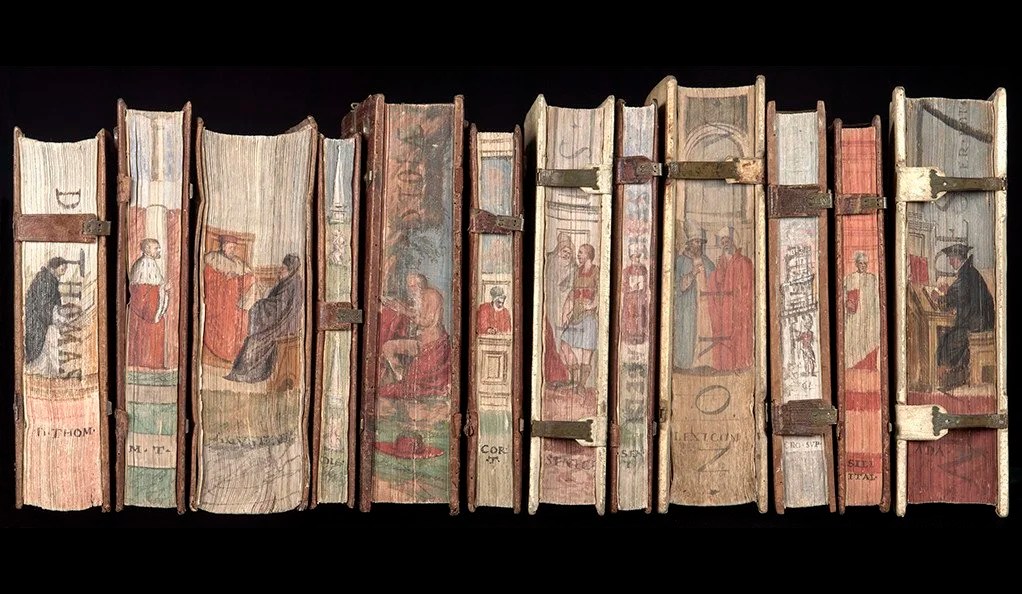
For someone who has spent much of his life surrounded by physical books I have been particularly ignorant about their anatomy. Crudely put, a book is a collection of pages pressed between two covers, the front and the back, with a spine holding the pages in place and usually bears the title and the name of the author of the book. This means that there are three edges of the pages showing, the top, which is known as the “head”, the bottom known as the “tail”, and the side facing the spine, the “fore”.
In the 10th century, the titles of books were written or impressed with heat on to the fore-edge of the book rather than the spine. This was because books were displayed horizontally on shelves and so their titles could be easily read. It took almost six hundred years before books were stored vertically and their titles embossed on their spines, leaving the fore-edge free. This was often used to display the owner’s name as books were valuable and precious things.
However, for the 16th century Italian painter and engraver, Cesare Vicellio, the fore-edge presented a blank canvas, upon which he could paint an original piece of art and which would be visible when the book was closed. Each painting would be different, providing another aid to identifying a particular book.
The English Restoration bookbinder and publisher, Samuel Mearne, when he was not hounding out of business printers and bookbinders who published literature that went against the current political dictates on religion and then publishing the confiscated works abroad at a great profit, is credited with taking Vicellio’s idea a step forward. Instead of painting on the flat edge of the pages when the book was shut, Meade fanned the pages slightly and put the paint on the inside edges so that the picture could only be seen when the pages were fanned.
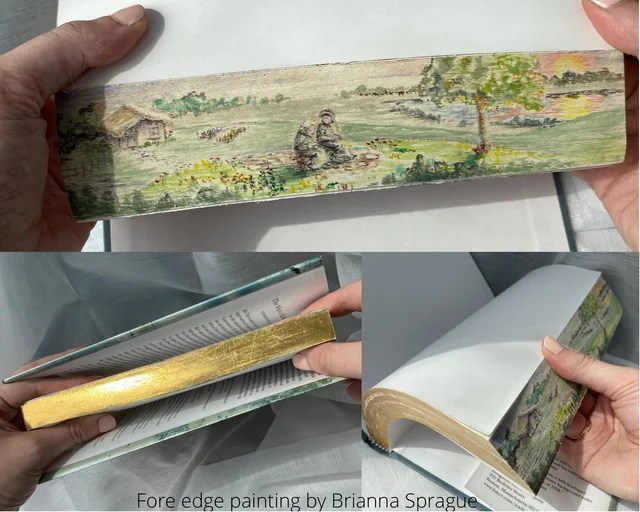
Known as “disappearing” or “vanishing” fore-edged painting, Mearne gave his books an added twist, adding gilt, a thin layer of gold, to the outside edges, a technique that is used to this day. As well as beautifying a volume, the gilt protected the page edges from tears, and further disguised the hidden artwork. His work is considered to be a high point of pre-Industrial bookbinding.
The more widespread use of hidden fore-edge painting did not take off until the late 18th century, thanks to an eccentric family of booksellers based in the Yorkshire town of Halifax, the Edwards. Like many booksellers of the time, they had their own bindery where they pioneered the practice of adding detailed urban and rural scenery to the edges of books. Their eye-catching creations even piqued the interest of King George III and his patronage boosted the fame of the Edwards shops. The names of the painters of most of the illustrations are, sadly, unknown.
The popularity of this form has waxed and waned ever since without ever dying out. There is one fore-edge artist still plying his art in the UK, Martin Frost, while Heritage Crafts calls the skill critically endangered. If you have a book with a fore-edge painting, cherish it. I am on the look-out for one for my collection.
 windowthroughtime